
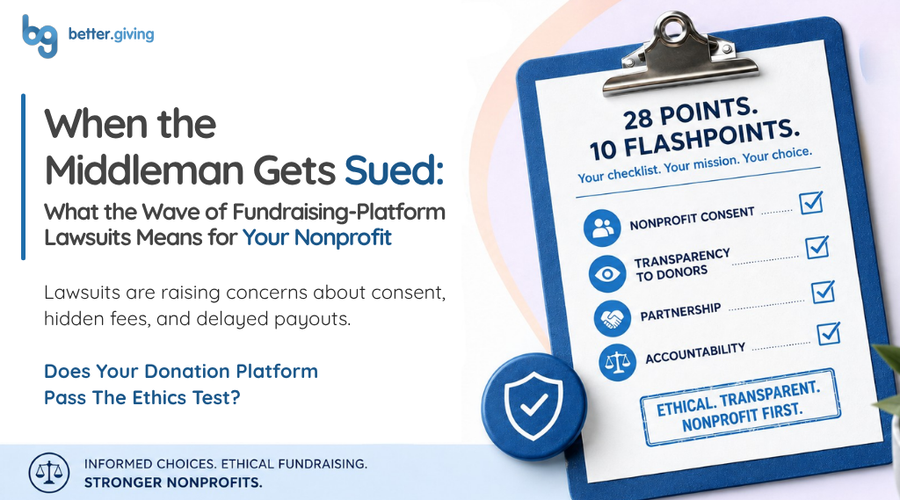
When the Middleman Gets Sued! What the Wave of Fundraising-Platform Lawsuits Means for Your Nonprofit
Posted: August 18, 2026
Author: Tim Stirrup
Online giving was supposed to make our lives easier. Click a button, the gift arrives, the donor gets a receipt. But over the past year a run of lawsuits, cease-and-desist orders, and regulator letters has pulled back the curtain on how some fundraising platforms actually operate — and much of what regulators and plaintiffs describe would alarm any executive director. Money raised in a nonprofit's name without permission. Donation pages the nonprofit never created. Fees and "tips" donors say they never agreed to. Funds that went in but, allegedly, never came out.
If your organization relies on a third-party platform to collect gifts, and almost all do, this is worth a few minutes of your attention.
Here is what is happening, what is still contested, and what it means for the way you choose and manage a platform.
A note on language before we start: several of these matters are active disputes. Where a claim has not been proven in court or resolved, we describe it as an allegation. That is not hedging for its own sake; it is how these cases actually stand.
The spark: GoFundMe's unauthorized pages
The current storm traces back to October 2025, when reporting revealed that GoFundMe had generated roughly 1.4 million donation pages for U.S. nonprofits that had never asked for them. Regulators allege the pages used nonprofits' names and information without consent, sometimes displayed inaccurate details, and were pushed up search rankings so they appeared above the nonprofits' own websites. They also allege the pages did not clearly disclose that donations could be routed through a donor-advised fund rather than going straight to the nonprofit, and that a default "tip" was directed to GoFundMe.
In March 2026, a bipartisan coalition of more than 20 state attorneys general, led by California, sent GoFundMe a letter demanding proof the pages had been removed and answers about its practices. GoFundMe has said it took the pages down and has pointed to California's platform law as permitting certain donation facilitation, and it maintains it is committed to transparency and compliance. Those questions remain the subject of ongoing scrutiny rather than a final ruling.
Alaska goes to court
Alaska decided a letter was not enough. On March 10, 2026, Alaska's attorney general filed six separate lawsuits in state court against GoFundMe, PayPal, nonprofit Navigator, JustGiving, Pledgeling, and Network for Good. The suits allege each company solicited donations for thousands of Alaska nonprofits without first obtaining the nonprofits' consent, in violation of Alaska's Charitable Solicitations Act, which has required registration since 1993.
The state is asking courts to order the removal of unauthorized pages for Alaska nonprofits and to impose civil penalties for each alleged violation. The defendants have not been found liable; these are allegations the state must still prove. Around the same time, three nonprofits filed a separate federal lawsuit alleging GoFundMe raised money in their names without authorization and damaged their reputations and donor trust. Again, these claims are yet to be tested.
Flipcause: when a platform allegedly stops paying out
The most painful story for nonprofits is Flipcause, a platform built for small organizations. Beginning in the fall of 2025, nonprofits reported that payouts had slowed to a trickle or stopped entirely.
On November 14, 2025, the California attorney general issued a cease-and-desist order demanding Flipcause halt all operations, alleging it was not properly registered as a fundraising platform and had failed to remit roughly $500,000 in donations despite repeated requests over more than 60 days. The order sought penalties of up to $70,000 and an accounting of the company's assets and clients going back to 2015. A parallel federal class action — now involving dozens of nonprofits across many states — alleges Flipcause unlawfully withheld hundreds of thousands of dollars in charitable funds, forcing organizations to suspend programs, lay off staff, and default on obligations. Nonprofits have reported far larger sums outstanding across the country.
Flipcause has contested aspects of the state's action and appealed, arguing it deserved notice before being penalized. In December 2025 the company filed for bankruptcy and moved toward liquidation, which has complicated recovery for the nonprofits still owed money. Underlying facts remain disputed and are working their way through the courts, but the practical lesson landed hard: a platform sitting between you and your donors is also sitting on your money.
GiveButter and the fight over "tips"
The newest front is a private one, and it targets a practice common across the whole industry rather than one failing company. In April 2026, a proposed class action was filed against GiveButter by a donor, Whitney McClintock, in connection with a $20 gift she made to a small nonprofit in December 2023.
The complaint alleges that GiveButter automatically adds two charges to donations — a processing fee and a "tip" — without a donor's affirmative consent, and that donors are directed into a GiveButter-controlled donation widget without being clearly told they are dealing with a third-party platform. It alleges neither charge is presented as genuinely optional and that the ways to remove them are buried in fine print. In McClintock's case, the complaint alleges she was charged an extra $0.91 processing fee and a $3.00 tip she never authorized on top of her $20 donation. The suit alleges the "tip" is effectively profit for GiveButter rather than something the nonprofit needs in order to receive the gift, and claims violations of Pennsylvania's consumer-protection law.
These are allegations, and GiveButter disputes them. The company markets a "tip-or-fee" model it describes as transparent, notes that its pages are labeled as powered by GiveButter, and says that when donors decline to cover fees, GiveButter absorbs them so the organization still receives the full donation. A consumer-advocacy group has separately raised concerns about how the tip prompt is presented, and similar hidden-fee complaints have been floated against a range of other platforms. Nothing here has been decided; the case is at an early stage.
It is worth being fair about context: GiveButter has also positioned itself as a responsible actor in this same period, launching a relief fund for nonprofits stranded by the Flipcause collapse. Both things can be true at once. A company can help peers in a crisis and still face unresolved allegations about its own fee design. That is precisely why "allegation" matters as a word.
The common thread
Strip away the individual company names and the same four expectations keep surfacing, and they line up almost exactly with the National Council of Nonprofits' Principles for Ethical Online Fundraising Platforms:
- Consent. Do not raise money in a nonprofit's name, or use its logo and identity, without written permission. This is the heart of the Alaska and GoFundMe matters.
- Transparency. Donors should see, at the moment of giving, exactly what is deducted, whether a "tip" goes to the platform, and whether a donor-advised fund sits in the middle. This is the heart of the GiveButter allegations.
- Timely remittance. Money raised for you belongs to you, and it should reach you quickly - within five business days under California's recent AB 488. This is the heart of the Flipcause action.
- Accountability. Platforms operating where donors live should be registered, in good standing, and reporting publicly.
Only California and Hawaii currently have comprehensive platform laws. Elsewhere, regulators are stretching older charitable-solicitation and consumer-protection statutes to fit, which is one reason the outcomes are still uncertain and why the word "alleged" appears so often.
What your nonprofit should do now
You do not have to wait for these cases to conclude to protect your organization.
- Know who is holding your money, and for how long. Find your platform's stated payout timeline in writing. If any of your donors are in California, that clock is five business days (although some platforms such as Better Giving allow you to choose to hold funds for longer), and the platform must be registered under AB 488.
- Look at your own donation page as a donor would. Is there a pre-checked tip? Is it obvious the fee is optional? Is it clear where the gift is going, and whether a DAF is involved? If a donor would be surprised by their receipt, that is a risk to your relationship, not just the platform's.
- Confirm consent and control. Make sure only you can create or edit campaigns in your name, that you can remove your organization without jumping through hoops, and that you can report a fraudulent page and have it frozen quickly.
- Keep your records portable. Export your donor, transaction, and payout data regularly. The Flipcause nonprofits who fared best were the ones who could reconstruct what they were owed.
- Check registration and good standing. Both your platform's and your own in the states where you raise money.
A practical way to run this review is to work through each of these questions against your current platform and put the unanswered ones, in writing, to your account team.
Better Giving has put together a free, no signup required checklist that’s easy to use and share.
A platform that will not answer a straightforward question about fees, consent, or payout timing has told you something useful.
None of this means abandoning online fundraising, which remains one of the most powerful and growing tools nonprofits have. It means treating the platform as a vendor you supervise, not a partner you trust blindly — because, as this year has shown, the law is increasingly expecting exactly that.
This article is for general information for nonprofit organizations and is not legal advice. The lawsuits and regulatory actions described are ongoing; allegations referenced here have not been proven, and the companies involved dispute many of them. Consult a qualified attorney about your organization's specific situation and your state's charitable-solicitation requirements.
FREE NONPROFIT RESOURCE
Is your fundraising platform meeting the right standards?
Use our free, no-signup checklist to review your platform’s fees, consent practices, payout timing, transparency, and accountability.